

Cover story · Mortgage / Finance / Real estate
The 7 Deadly Sins of Mortgage
Seven human distortions that can make money, housing, and borrowing harder to read — and the better instinct that gives you a way back.

ForBorrowers, buyers, homeowners, and investors.
Read time15 minutes, with room to pause.
IntentAwareness, not shame.
Start with the distinction
Two ways a money story gets misread.
Misread
How the system fails to read people.
Institutions, systems, and underwriting boxes can flatten a complex person into the inputs they know how to process.
The question: what context is missing from the read?
The 7 Deadly Sins of Mortgage
How people distort their own money story.
People can distort money, housing, and borrowing in ways that hurt themselves — even while a system is also missing the full picture.
The question: what habit is narrowing the decision?
The line to remember
“The sin is not needing a Non-QM loan. The sin is lying to yourself, outsourcing your judgment, chasing image, or refusing truth.”
A note on the word sin: These are human distortions, not moral condemnations. They are tendencies, not identities. The goal is awareness — a way to notice what is shaping a decision before shame, urgency, or someone else’s definition of “normal” takes over.
This framework applies to borrowers, buyers, homeowners, and investors. It does not shame anyone for having complex finances or needing a Non-QM option. A different loan path can be a responsible tool; the work is to understand the tradeoffs and tell the truth about the plan.
The field guide
Seven tendencies.
Seven ways back.
Use the antidote as a question, not a label. The point is to widen the read.
Treating confidence as a substitute for context, counsel, and a plan.
Main harm: Teachability, planning, trust, and clarity
Treating leverage, property, cash-out, square footage, or upside as inherently good because the number is bigger.
Main harm: Margin, safety, stewardship, and contentment
Letting a house become an identity, a finish package, or a fantasy that outranks the numbers and the red flags.
Main harm: Objectivity, discipline, negotiation, and timing
Using another person's home, rate, age, or progress as the measuring stick for your own next move.
Main harm: Peace, discernment, gratitude, and alignment
Letting rage, hurt, or the need to prove a point choose the property, timing, negotiation, or financing move.
Main harm: Judgment, relationships, negotiation, timing, and self-control
Confusing access with permission and turning a larger payment, lifestyle, furniture plan, upgrade, subscription, HELOC, or cash-out into a default yes.
Main harm: Breathing room, sustainability, family peace, and resilience
Treating avoidance as neutral: not checking credit, organizing documents, asking questions, budgeting, handling tax returns, fixing issues, or preparing before contract.
Main harm: Preparation, options, execution, timing, and outcomes
Pride
self-reliance without wisdom
Mortgage meaning
“I know enough. I don't need help. I don't need to listen.”
What it looks like in real life
Refusing advice, hiding inconvenient details, assuming preapproval equals understanding, or forcing an outcome because changing course feels like losing.
How it harms a borrower, buyer, homeowner, or investor
A borrower can miss a better structure because they never ask the second question. A buyer can mistake a preapproval for a full reading of the deal. An investor can protect their certainty at the expense of their margin.
How the system can make it worse
Fast, checkbox-based systems can reward a tidy story and quietly reinforce overconfidence. A preapproval letter may feel like a verdict when it is only a snapshot of what was translated into the box.
The antidote
Humility
Name the tendency without becoming it. Make the next choice wider, calmer, and more honest.
A real-world pattern
A self-employed buyer receives a preapproval, skips the planning conversation, then learns that the income strategy behind the letter does not fit the property or timeline they actually want.
Hard truth / takeaway
Knowing a lot is not the same as understanding the whole decision. The strongest move may be the one that lets new information change your mind.
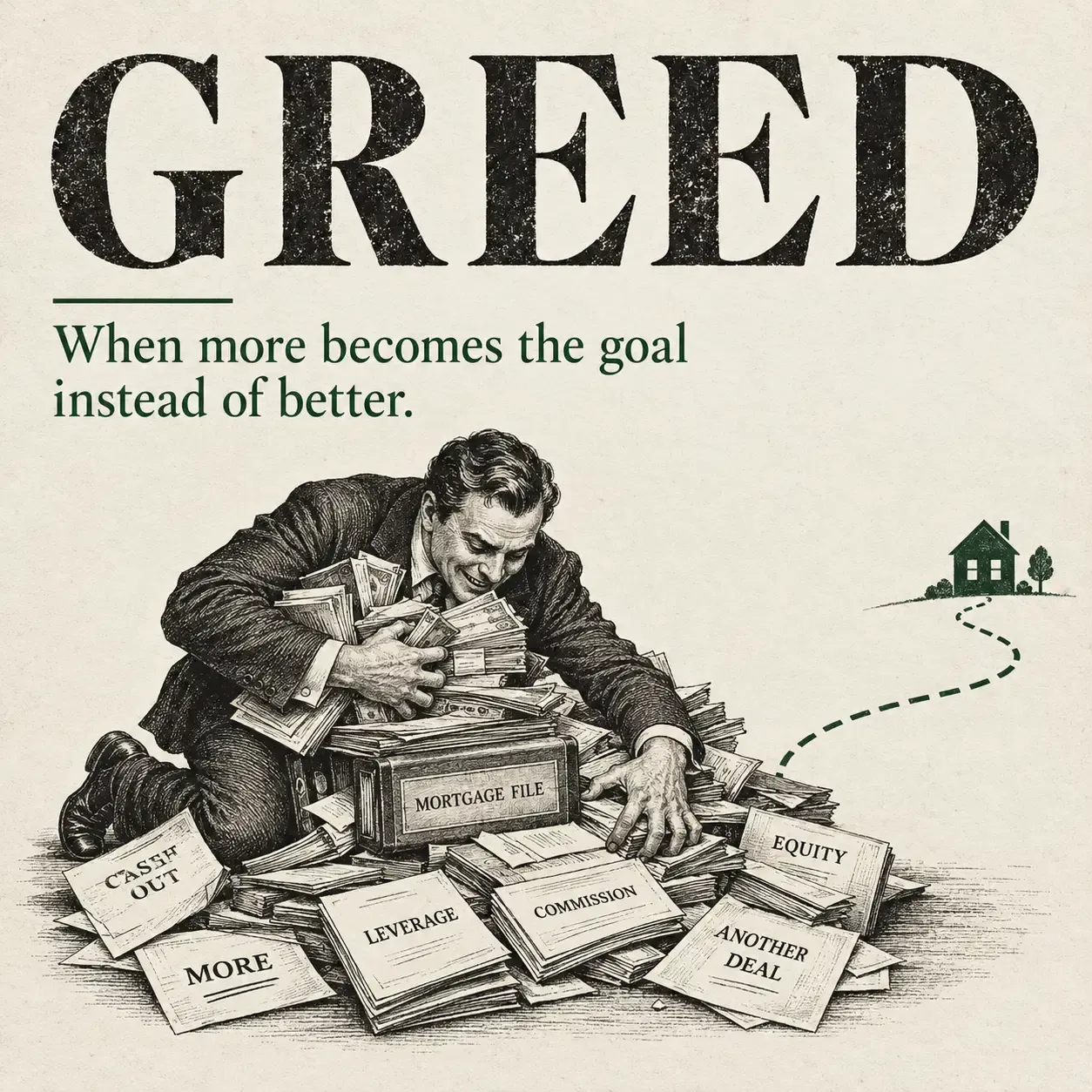
Greed
more without stewardship
Mortgage meaning
“More is always better.”
What it looks like in real life
Pursuing more leverage, another property, a larger cash-out, extra square footage, or every possible point of upside without asking what the larger plan can responsibly carry.
How it harms a borrower, buyer, homeowner, or investor
The borrower may win the asset and lose the breathing room. More leverage can turn a flexible plan into a fragile one. More property can become more maintenance, more vacancy exposure, and more decisions than the household or portfolio can steward well.
How the system can make it worse
A system that celebrates maximum approval, projected appreciation, or the biggest possible loan can turn capacity into a target. The fact that a structure can be built does not make it wise to build.
The antidote
Stewardship
Name the tendency without becoming it. Make the next choice wider, calmer, and more honest.
A real-world pattern
An investor cashes out of a stable property to chase a larger portfolio, only to discover that the new payments leave no room for a vacancy, repair, or ordinary season of lower income.
Hard truth / takeaway
The largest version of a plan is not automatically the strongest version. Stewardship asks what you can carry when the optimistic case is not the only case.
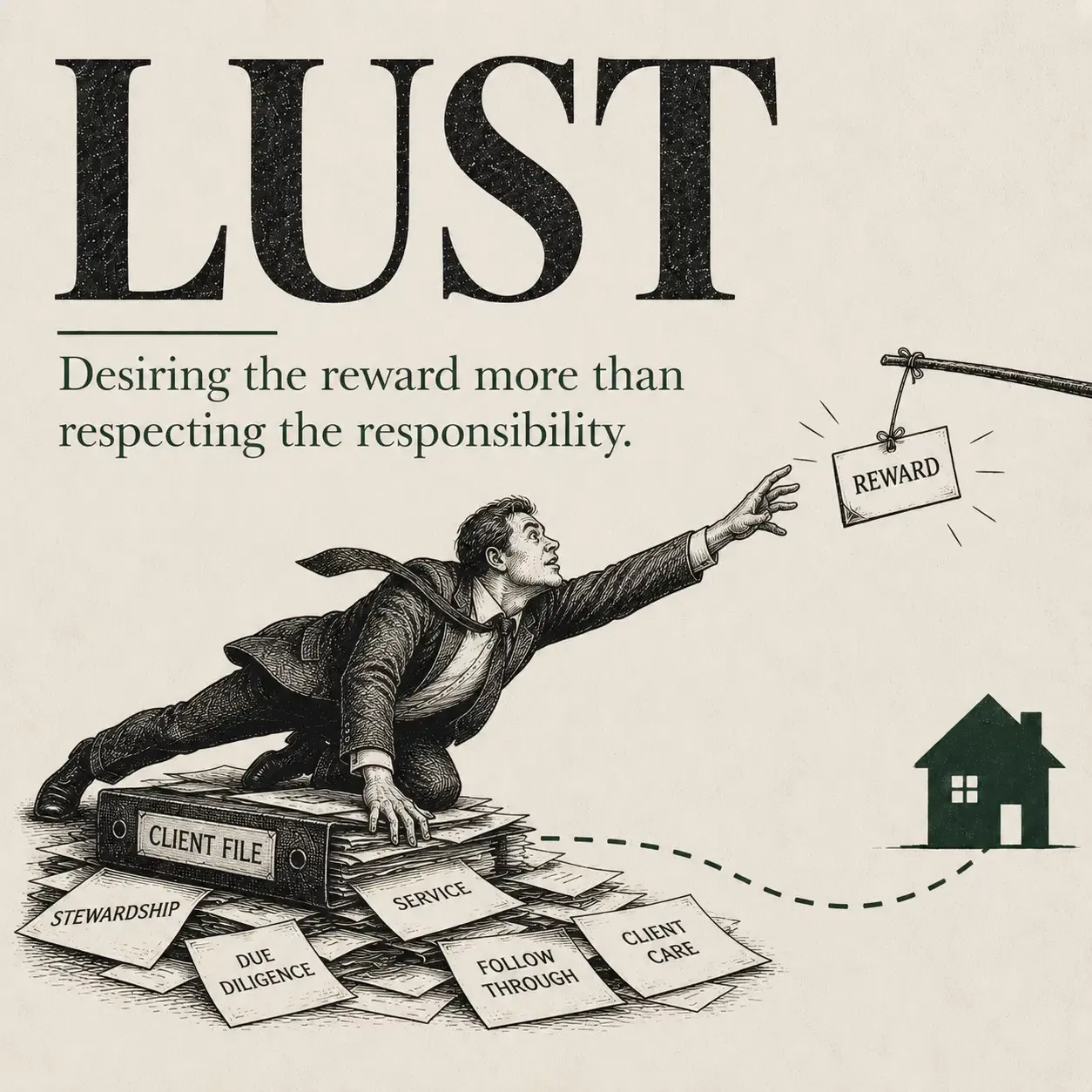
Lust
desire without discernment
Mortgage meaning
“I want this house so badly that I stop thinking clearly.”
What it looks like in real life
Falling for the finishes, projecting a new identity onto an address, dismissing red flags, rationalizing bad numbers, or stretching because walking away feels unbearable.
How it harms a borrower, buyer, homeowner, or investor
Desire narrows the field of view. The buyer may overpay, accept a bad repair story, lose negotiation leverage, or force a payment that makes the home harder to enjoy once the closing photos are over.
How the system can make it worse
Competitive markets, countdown clocks, and polished listings are designed to intensify urgency. A process that only asks whether the payment can technically work may not make room for whether the decision still works when the feeling settles.
The antidote
Discernment
Name the tendency without becoming it. Make the next choice wider, calmer, and more honest.
A real-world pattern
A buyer falls for a renovated kitchen, ignores an aggressive payment and unresolved inspection issue, and later realizes the home required a level of stretching the original plan never allowed.
Hard truth / takeaway
A beautiful house can still be a bad decision. Discernment protects the future version of you from the intensity of the present moment.
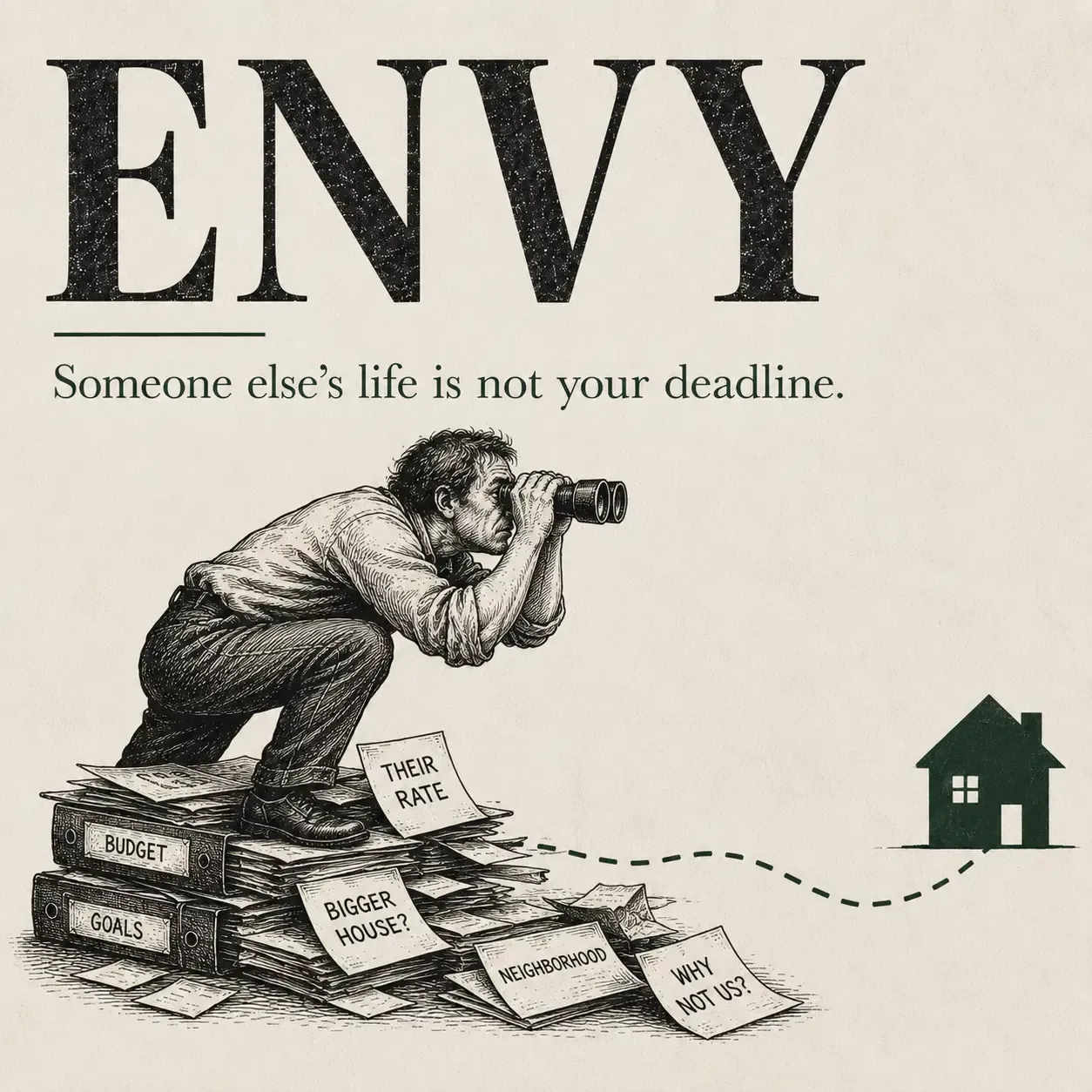
Envy
comparison without perspective
Mortgage meaning
“Why do they get that and I don't?”
What it looks like in real life
Comparing homes, rates, age, income, and visible progress; assuming the highlight reel contains the whole balance sheet; or making a decision mainly to keep up.
How it harms a borrower, buyer, homeowner, or investor
Comparison can make a sound plan feel like failure. It can push a buyer into a payment that does not fit, turn a homeowner against a useful current position, or make an investor chase a strategy that is not aligned with their resources.
How the system can make it worse
Public rate talk and social proof flatten different situations into one scoreboard. The system sees inputs; envy fills in the missing story with assumptions about what everyone else has, pays, and knows.
The antidote
Gratitude
Name the tendency without becoming it. Make the next choice wider, calmer, and more honest.
A real-world pattern
After seeing a friend buy a larger home, a household abandons a patient savings plan and stretches into a purchase that leaves less room for the family priorities they were actually trying to protect.
Hard truth / takeaway
Someone else's outcome is not evidence about your right timing. Perspective makes room for a plan that fits the life you are really building.
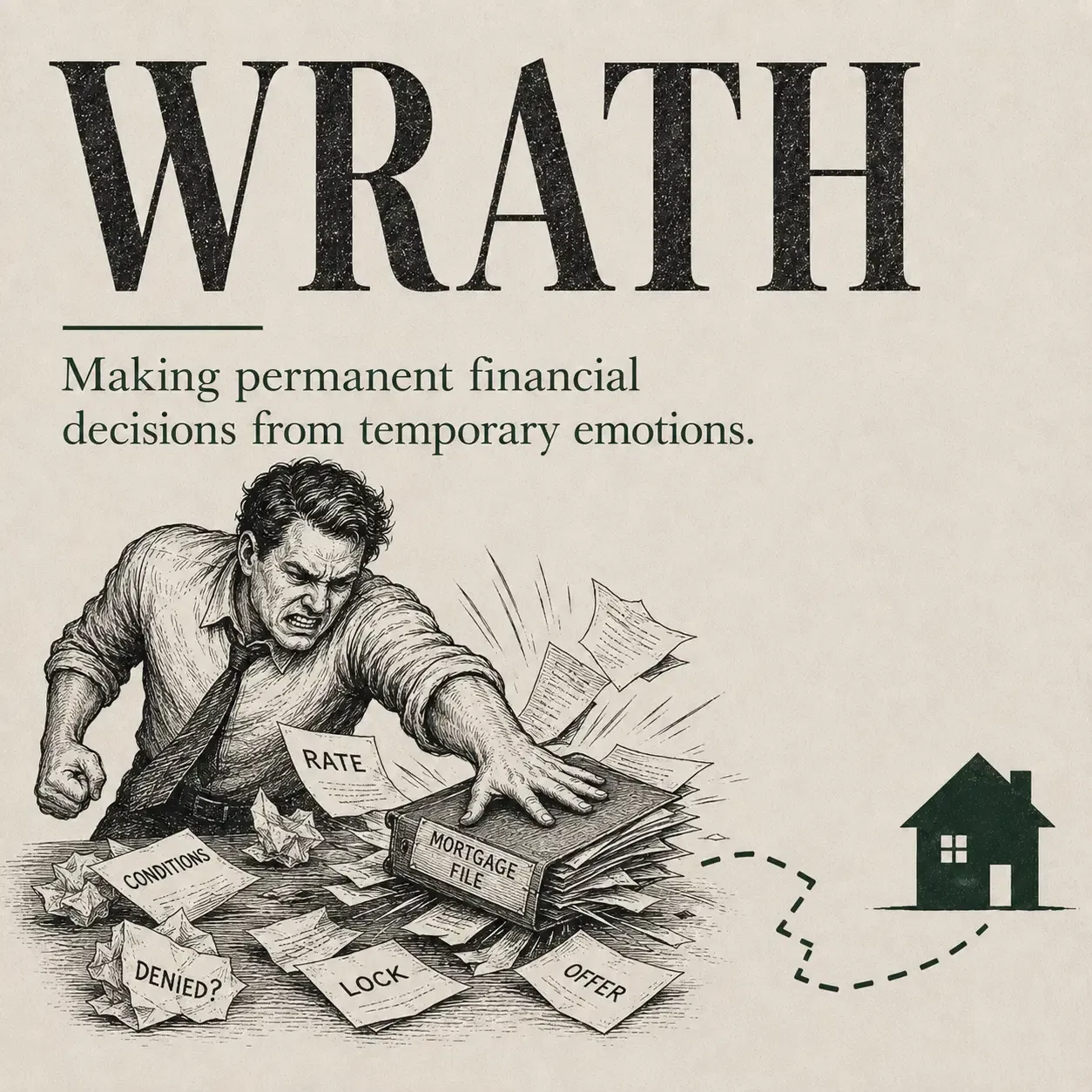
Wrath
anger without control
Mortgage meaning
“My anger will decide.”
What it looks like in real life
Making a revenge decision after a divorce or breakup, rage-buying, blowing up a deal, rejecting useful advice, or turning denial into defiance just to regain a sense of control.
How it harms a borrower, buyer, homeowner, or investor
Anger can make an expensive decision feel emotionally cheap. It can burn relationships, surrender negotiation leverage, create a rushed purchase, or turn one disappointing answer into a longer and more costly detour.
How the system can make it worse
Deadlines, adversarial language, and opaque decisions can make people feel cornered. When the system creates friction without explanation, wrath can feel like the only remaining form of agency.
The antidote
Self-command
Name the tendency without becoming it. Make the next choice wider, calmer, and more honest.
A real-world pattern
A separating couple makes a rushed refinance and property decision to hurt the other person, then has to unwind choices made for emotional distance instead of long-term stability.
Hard truth / takeaway
Your anger may be justified and still be a poor financial advisor. Self-command is not passivity; it is keeping the decision yours.
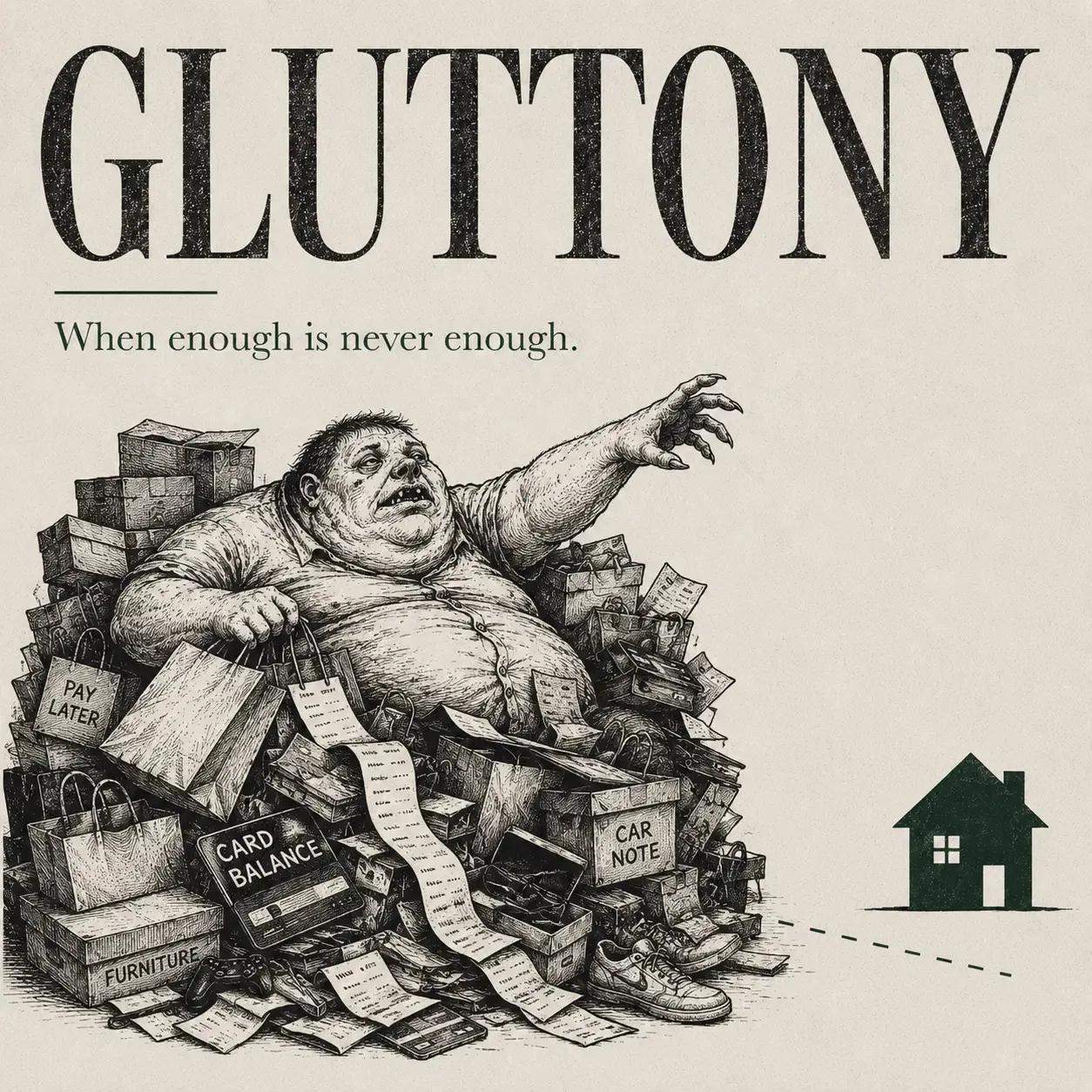
Gluttony
consumption without limits
Mortgage meaning
“If I can consume it, I should.”
What it looks like in real life
Buying the payment, filling the home immediately, upgrading every finish, adding debt and subscriptions, spending a HELOC or cash-out, or pursuing an oversized forever-home aspiration because the budget technically allows it.
How it harms a borrower, buyer, homeowner, or investor
Greed wants more; gluttony consumes too much. The result is a plan with no pause between wants, a household that cannot absorb a surprise, and a home that quietly dictates every other choice.
How the system can make it worse
Affordability calculators and sales processes often treat the upper limit as a recommendation. Easy access to credit can hide the difference between a one-time need, an ongoing obligation, and a habit that compounds.
The antidote
Temperance
Name the tendency without becoming it. Make the next choice wider, calmer, and more honest.
A real-world pattern
A homeowner uses cash-out for upgrades, furniture, subscriptions, and a new vehicle, then discovers that the house is full but the budget has no resilience left.
Hard truth / takeaway
A payment that fits today can still crowd out the life it was meant to support. Temperance keeps “can” from becoming “must.”
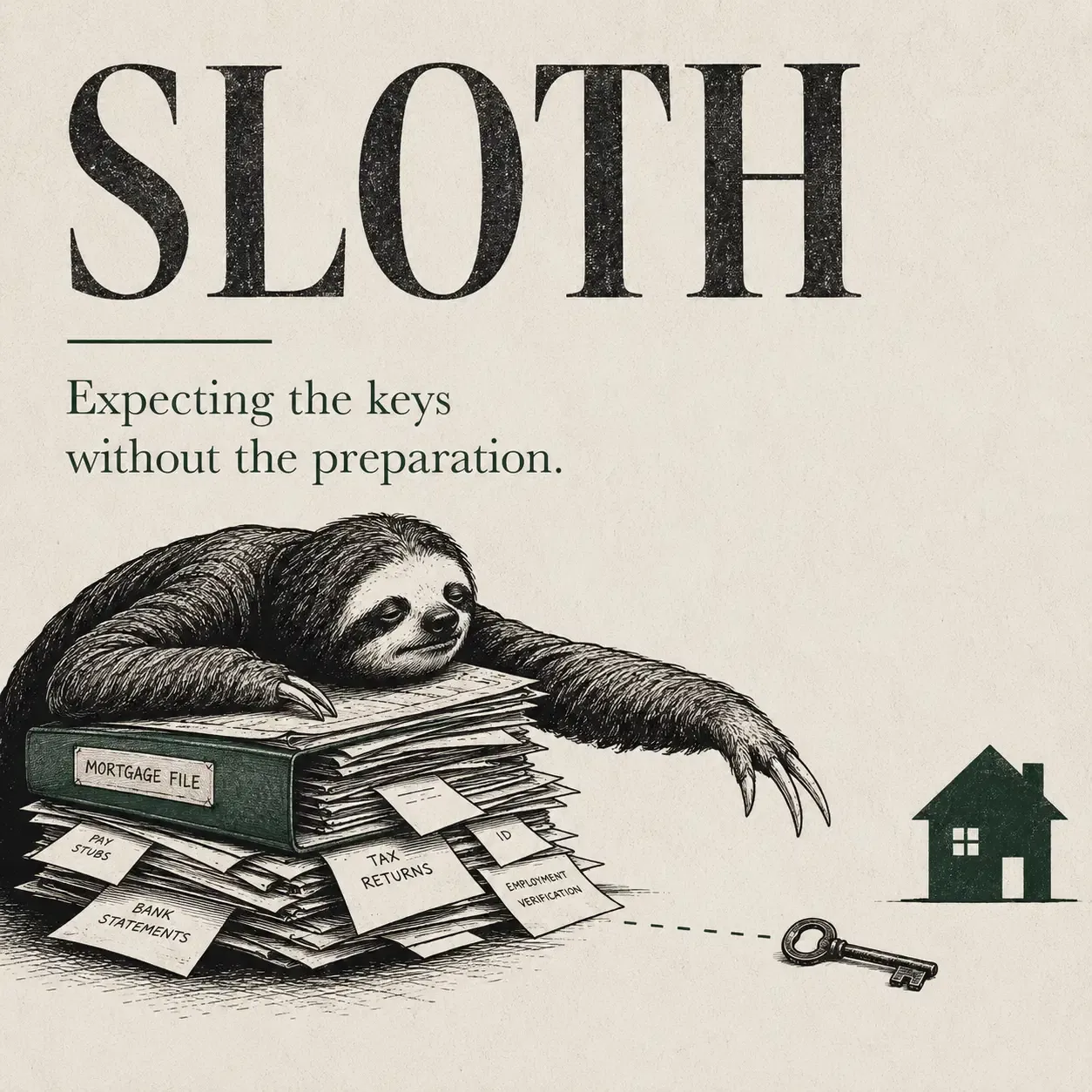
Sloth
delay without responsibility
Mortgage meaning
“I'll deal with it later.”
What it looks like in real life
This is not cartoon laziness. It is neglect that compounds: unopened statements, unfiled returns, unexplained deposits, unanswered questions, and small credit or property issues left until the timeline is tight.
How it harms a borrower, buyer, homeowner, or investor
Delay removes options. A borrower may lose a program, miss a repair window, weaken a negotiation, or discover that the issue was fixable only after it became urgent and expensive.
How the system can make it worse
Complex requirements and unclear handoffs can make avoidance feel rational. When nobody explains the next small action, the pile grows until the system reads the delay as risk or the contract runs out of room.
The antidote
Diligence
Name the tendency without becoming it. Make the next choice wider, calmer, and more honest.
A real-world pattern
A buyer waits to pull credit and organize tax returns until after an offer is accepted, then learns that a fixable documentation issue changes both timing and available options.
Hard truth / takeaway
Later is not a plan. Diligence is the small, unglamorous work that preserves choices before the decision becomes expensive.
The seven lockups
Name the habit. Choose the antidote.
The framework is a mirror, not a sentence. You can be proud and still ask for help. You can want more and still practice stewardship. You can need a Non-QM loan and still tell the truth.
Keep pulling the thread
A better next question beats a fast answer.
Education first. Bring the useful part with you, whether or not your next step is a mortgage conversation.
Related answer
Why a profitable business owner can still get denied ↗
Clear up a myth
Is Non-QM the same as subprime? ↗
Three Levers
Read income, assets, and credit in context ↗
Topic hub
Business owners and the income story behind the file ↗
Topic hub
Real estate investors and the next property decision ↗
Soft next step